A) 20.08%
B) 20.59%
C) 21.11%
D) 21.64%
E) 22.18%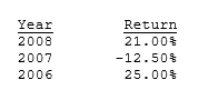
G) A) and C)
Correct Answer

verified
Correct Answer
verified
A) Portfolio AB's standard deviation is 17.5%.
B) The stocks are not in equilibrium based on the CAPM; if A is valued correctly, then B is overvalued.
C) The stocks are not in equilibrium based on the CAPM; if A is valued correctly, then B is undervalued.
D) Portfolio AB's expected return is 11.0%.
E) Portfolio AB's beta is less than 1.2.
G) C) and D)
Correct Answer
verified
Correct Answer
verified
B) False
Correct Answer
verified
Correct Answer
verified
A) When held in isolation, Stock A has more risk than Stock B.
B) Stock B must be a more desirable addition to a portfolio than A.
C) Stock A must be a more desirable addition to a portfolio than B.
D) The expected return on Stock A should be greater than that on B.
F) A) and B)
Correct Answer
verified
Correct Answer
verified
A) A large portfolio of randomly selected stocks will always have a standard deviation of returns that is less than the standard deviation of a portfolio with fewer stocks, regardless of how the stocks in the smaller portfolio are selected.
B) Diversifiable risk can be reduced by forming a large portfolio, but normally even highly-diversified portfolios are subject to market (or systematic) risk.
C) A large portfolio of randomly selected stocks will have a standard deviation of returns that is greater than the standard deviation of a 1-stock portfolio if that one stock has a beta less than 1.0.
D) A large portfolio of stocks whose betas are greater than 1.0 will have less market risk than a single stock with a beta = 0.8.
F) B) and C)
Correct Answer
verified
Correct Answer
verified
A) 14.89%
B) 15.68%
C) 16.50%
D) 17.33%
E) 18.19%
G) None of the above
Correct Answer
verified
Correct Answer
verified
A) Stock A's beta is 0.8333.
B) Since the two stocks have zero correlation, Portfolio AB is riskless.
C) Stock B's beta is 1.0000.
D) Portfolio AB's required return is 11%.
E) Portfolio AB's standard deviation is 25%.
G) C) and E)
Correct Answer
verified
Correct Answer
verified
A) Beta is measured by the slope of the security market line.
B) If the risk-free rate rises, then the market risk premium must also rise.
C) If a company's beta is halved, then its required return will also be halved.
D) If a company's beta doubles, then its required return will also double.
E) The slope of the security market line is equal to the market risk premium, (rM − rRF) .
G) C) and D)
Correct Answer
verified
Correct Answer
verified
B) False
Correct Answer
verified
Correct Answer
verified
A) If expected inflation remains constant but the market risk premium (rM − rRF) declines, the required return of Stock LB will decline but the required return of Stock HB will increase.
B) If both expected inflation and the market risk premium (rM − rRF) increase, the required return on Stock HB will increase by more than that on Stock LB.
C) If both expected inflation and the market risk premium (rM − rRF) increase, the required returns of both stocks will increase by the same amount.
D) Since the market is in equilibrium, the required returns of the two stocks should be the same.
F) B) and C)
Correct Answer
verified
Correct Answer
verified
A) systematic risk factors that can be diversified away.
B) company-specific risk factors that can be diversified away.
C) among the factors that are responsible for market risk.
D) risks that are beyond the control of investors and thus should not be considered by security analysts or portfolio managers.
E) irrelevant except to governmental authorities like the Federal Reserve.
G) B) and C)
Correct Answer
verified
Correct Answer
verified
A)
B)
C)
D)
E)
G) A) and C)
Correct Answer
verified
Correct Answer
verified
A) Stock B's required return is double that of Stock A's.
B) If the marginal investor becomes more risk averse, the required return on Stock B will increase by more than the required return on Stock A.
C) An equally weighted portfolio of Stocks A and B will have a beta lower than 1.2.
D) If the marginal investor becomes more risk averse, the required return on Stock A will increase by more than the required return on Stock B.
F) A) and D)
Correct Answer
verified
Correct Answer
verified
B) False
Correct Answer
verified
Correct Answer
verified
A) If the risk-free rate increases but the market risk premium stays unchanged, Stock B's required return will increase by more than Stock A's.
B) Stock B's required rate of return is twice that of Stock A.
C) If Stock A's required return is 11%, then the market risk premium is 5%.
D) If Stock B's required return is 11%, then the market risk premium is 5%.
F) B) and D)
Correct Answer
verified
Correct Answer
verified
A) The required return would increase for both stocks but the increase would be greater for Stock B than for Stock A.
B) The required return would decrease by the same amount for both Stock A and Stock B.
C) The required return would increase for Stock A but decrease for Stock B.
D) The required return on Portfolio P would remain unchanged.
E) The required return would increase for Stock B but decrease for Stock A.
G) A) and D)
Correct Answer
verified
Correct Answer
verified
A) If you invest $50,000 in Stock X and $50,000 in Stock Y, your 2- stock portfolio would have a beta significantly lower than 1.0, provided the returns on the two stocks are not perfectly correlated.
B) Stock Y's realized return during the coming year will be higher than Stock X's return.
C) If the expected rate of inflation increases but the market risk premium is unchanged, the required returns on the two stocks should increase by the same amount.
D) Stock Y's return has a higher standard deviation than Stock X.
F) C) and D)
Correct Answer
verified
Correct Answer
verified
Showing 121 - 137 of 137
Related Exams