Filters
Question type

Study Flashcards

Which equation is correct?


A) E = -(RT/nF) lnK
B) E° = (RT/nF) lnK
C) E° = (RT/nF) lnQ
D) E = -(RT/nF) lnQ
E) E = E° + lnQ

F) A) and B)
G) A) and C)

Correct Answer

verifed

verified

A voltaic cell consists of an Au/Au3+ electrode (E° = 1.50 V) and a Cu/ Cu2+ electrode (E° = 0.34 V) .Calculate [Au3+] if [Cu2+] = 1.20 M and Ecell = 1.15 V at 25°C.


A) 0.0010 M
B) 0.0020 M
C) 0.010 M
D) 0.020 M
E) 0.41 M

F) A) and E)
G) A) and D)

Correct Answer

verifed

verified

What mass of copper can be deposited by the passage of 12.0 A for 25.0 min through a solution of copper(II) sulfate? [1 C = 1 A•s; F = 96,500 C]


A) 5.93 g
B) 3.95 g
C) 1.97 g
D) 11.85 g
E) 29.6 g

F) All of the above
G) A) and C)

Correct Answer

verifed

verified

_______________ is a process used to coat iron in order to protect it from corrosion.

Correct Answer

verifed

verified

Galvanizat...

View Answer

A current of 250.A flows for 24.0 hours at an anode where the reaction occurring is as follows: Mn2+(aq) + 2H2O(l) → MnO2(s) + 4H+(aq) + 2e- What mass of MnO2 is deposited at this anode?


A) 19.5 kg
B) 12.9 kg
C) 9.73 kg
D) 4.87 kg
E) 2.43 kg

F) A) and C)
G) D) and E)

Correct Answer

verifed

verified

Based on the data presented below,which is the strongest oxidizing agent? Half-Reaction E°(V) Al3++ 3e- → Al(s) -1.66 AgBr(s) + e- → Ag(s) + Br- +0.07 Sn4++ 2e- → Sn2+ +0.14 Fe3++ e- → Fe2+ +0.77


A) Fe3+
B) Fe2+
C) Br-
D) Al3+
E) Al(s)

F) B) and C)
G) A) and E)

Correct Answer

verifed

verified

Given the following standard reduction potentials in acid solution O2 + 4H+ + 4e- → 2H2O E° = +1.23V Sn4+ + 2e- → Sn2+ E° = +0.13V Zn2+ + 2e- → Zn(s)E° = -0.76V write the formula of the strongest reducing agent.

Correct Answer

verifed

verified

A SHE has the acid concentration of 1 M and the H2 pressure is 1 atm.

A) True
B) False

Correct Answer

verifed

verified

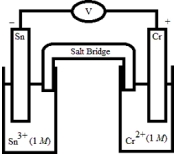
Based on the following electrochemical cell,what is the standard reduction potential of metal M at 298 K? (R = 8.314 J/K • mol,F = 96500 C/mol) Based on the following electrochemical cell,what is the standard reduction potential of metal M at 298 K? (R = 8.314 J/K • mol,F = 96500 C/mol)    Half-Reaction E° (V)  Fe<sup>2+</sup>(aq) + 2e<sup>-</sup> → Fe(s) -0.44 A) -0.54 V B) +0.60 V C) -0.30 V D) +0.56 V E) -0.28 V Half-Reaction E° (V) Fe2+(aq) + 2e- → Fe(s) -0.44


A) -0.54 V
B) +0.60 V
C) -0.30 V
D) +0.56 V
E) -0.28 V

F) B) and E)
G) A) and C)

Correct Answer

verifed

verified

Based on the data presented below,which is the strongest reducing agent? PbI2(s) + 2e- Based on the data presented below,which is the strongest reducing agent? PbI<sub>2</sub>(s) + 2e<sup>-</sup>   Pb(s) +2I<sup>-</sup>(aq) E° = -0.365 V Ca<sup>2+</sup>(aq) + 2e<sup>-</sup>   Ca(s) E° = -2.868 V Pt<sup>2+</sup>(aq) + 2e<sup>-</sup>   Pt(s) E° = 1.18 V Br<sub>2</sub>(l) + 2e<sup>-</sup>   2Br<sup>-</sup>(aq) E° = 1.066 V A) Pb(s)  B) Ca(s)  C) Pt(s)  D) Br<sup>-</sup>(aq)  E) Pt<sup>2+</sup>(aq) Pb(s) +2I-(aq) E° = -0.365 V Ca2+(aq) + 2e- Based on the data presented below,which is the strongest reducing agent? PbI<sub>2</sub>(s) + 2e<sup>-</sup>   Pb(s) +2I<sup>-</sup>(aq) E° = -0.365 V Ca<sup>2+</sup>(aq) + 2e<sup>-</sup>   Ca(s) E° = -2.868 V Pt<sup>2+</sup>(aq) + 2e<sup>-</sup>   Pt(s) E° = 1.18 V Br<sub>2</sub>(l) + 2e<sup>-</sup>   2Br<sup>-</sup>(aq) E° = 1.066 V A) Pb(s)  B) Ca(s)  C) Pt(s)  D) Br<sup>-</sup>(aq)  E) Pt<sup>2+</sup>(aq) Ca(s) E° = -2.868 V Pt2+(aq) + 2e- Based on the data presented below,which is the strongest reducing agent? PbI<sub>2</sub>(s) + 2e<sup>-</sup>   Pb(s) +2I<sup>-</sup>(aq) E° = -0.365 V Ca<sup>2+</sup>(aq) + 2e<sup>-</sup>   Ca(s) E° = -2.868 V Pt<sup>2+</sup>(aq) + 2e<sup>-</sup>   Pt(s) E° = 1.18 V Br<sub>2</sub>(l) + 2e<sup>-</sup>   2Br<sup>-</sup>(aq) E° = 1.066 V A) Pb(s)  B) Ca(s)  C) Pt(s)  D) Br<sup>-</sup>(aq)  E) Pt<sup>2+</sup>(aq) Pt(s) E° = 1.18 V Br2(l) + 2e- Based on the data presented below,which is the strongest reducing agent? PbI<sub>2</sub>(s) + 2e<sup>-</sup>   Pb(s) +2I<sup>-</sup>(aq) E° = -0.365 V Ca<sup>2+</sup>(aq) + 2e<sup>-</sup>   Ca(s) E° = -2.868 V Pt<sup>2+</sup>(aq) + 2e<sup>-</sup>   Pt(s) E° = 1.18 V Br<sub>2</sub>(l) + 2e<sup>-</sup>   2Br<sup>-</sup>(aq) E° = 1.066 V A) Pb(s)  B) Ca(s)  C) Pt(s)  D) Br<sup>-</sup>(aq)  E) Pt<sup>2+</sup>(aq) 2Br-(aq) E° = 1.066 V


A) Pb(s)
B) Ca(s)
C) Pt(s)
D) Br-(aq)
E) Pt2+(aq)

F) B) and C)
G) D) and E)

Correct Answer

verifed

verified

B

What is E°cell for the following reaction? 2 Ag(s) + Sn2+(aq) → 2 Ag+(aq) + Sn(s) Ag+(aq) + e- → Ag(s) E° = 0.80 V Sn4+(aq) + 2e? →Sn2+(aq) E° = 0.13 V Sn2+(aq) + 2e- → Sn(s) E° = -0.14 V


A) +0.94 V
B) -0.94 V
C) +0.67 V
D) -0.67 V
E) +1.34 V

F) B) and D)
G) A) and B)

Correct Answer

verifed

verified

B

What is ΔG° at 298 K for the following reaction? (F = 96,500 C • mol-1) 2Cr3+(aq) + 6Hg(l) → 2Cr(s) + 3Hg22+(aq) E°cell = 1.59V


A) -921 kJ/mol
B) -767 kJ/mol
C) -460 kJ/mol
D) -307 kJ/mol
E) -1840 kJ/mol

F) A) and C)
G) All of the above

Correct Answer

verifed

verified

Aluminum does not corrode in the same manner as iron does,because


A) aluminum does not react with oxygen gas.
B) a protective layer of aluminum oxide forms on the metal surface.
C) aluminum is harder to oxidize than iron.
D) iron gives cathodic protection to aluminum.
E) the electrical circuit cannot be completed on an aluminum surface.

F) A) and D)
G) B) and E)

Correct Answer

verifed

verified

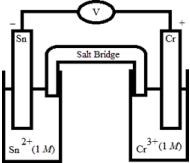
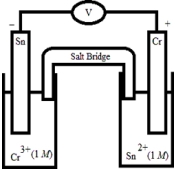
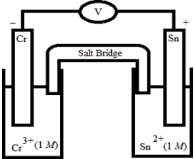
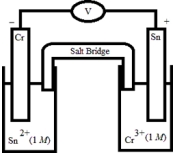
Which electrochemical cell pictured below corresponds to the following cell diagram? Cr(s) | Cr3+(aq,1.0 M) || Sn2+(aq,1.0 M) | Sn(s)


A) Which electrochemical cell pictured below corresponds to the following cell diagram? Cr(s) | Cr<sup>3+</sup>(aq,1.0 M) || Sn<sup>2+</sup>(aq,1.0 M) | Sn(s)  A)    B)    C)    D)    E)
B) Which electrochemical cell pictured below corresponds to the following cell diagram? Cr(s) | Cr<sup>3+</sup>(aq,1.0 M) || Sn<sup>2+</sup>(aq,1.0 M) | Sn(s)  A)    B)    C)    D)    E)
C) Which electrochemical cell pictured below corresponds to the following cell diagram? Cr(s) | Cr<sup>3+</sup>(aq,1.0 M) || Sn<sup>2+</sup>(aq,1.0 M) | Sn(s)  A)    B)    C)    D)    E)
D) Which electrochemical cell pictured below corresponds to the following cell diagram? Cr(s) | Cr<sup>3+</sup>(aq,1.0 M) || Sn<sup>2+</sup>(aq,1.0 M) | Sn(s)  A)    B)    C)    D)    E)
E) Which electrochemical cell pictured below corresponds to the following cell diagram? Cr(s) | Cr<sup>3+</sup>(aq,1.0 M) || Sn<sup>2+</sup>(aq,1.0 M) | Sn(s)  A)    B)    C)    D)    E)

F) None of the above
G) B) and E)

Correct Answer

verifed

verified

A metal object is to be gold-plated by an electrolytic procedure using aqueous AuCl3 electrolyte.How much gold may be deposited in 3.0 min by a constant current of 10.A?


A) 6.2 × 10⁻³ mol
B) 9.3 × 10⁻³ mol
C) 1.8 × 10⁻² mol
D) 3.5 × 10⁻⁵ mol
E) 1.6 × 10² mol

F) C) and D)
G) B) and D)

Correct Answer

verifed

verified

If E° for X + e- → Y is larger than E° for A + 2e- → B,then in a spontaneous process under standard-state conditions,


A) X will oxidize A.
B) Y will oxidize A.
C) Y will reduce A.
D) B will oxidize X.
E) B will reduce X.

F) C) and D)
G) B) and D)

Correct Answer

verifed

verified

Which is not a redox reaction?


A) Al(OH) 4-(aq) + 4H+(aq) → Al3+(aq) + 4H2O(l)
B) C6H12O6(s) + 6O2(g) → 6CO2(g) + 6H2O(l)
C) Na6FeCl8(s) + 2Na(l) → 8NaCl(s) + Fe(s)
D) 2H2O2(aq) → 2H2O(l) + O2(g)
E) CO2(g) + H2(g) → CO(g) + H2O(g)

F) C) and D)
G) B) and C)

Correct Answer

verifed

verified

A voltaic cell consists of a Cd/Cd2+ electrode (E° = -0.40 V) and a Fe/Fe2+ electrode (E° = -0.44 V) .If Ecell = 0 and the temperature is 25°C,what is the ratio [Fe2+]/[Cd2+]?


A) 2.3 × 101
B) 1.0 × 101
C) 1.0
D) 1.0 × 10⁻¹
E) 5.0 × 10⁻²

F) A) and E)
G) A) and C)

Correct Answer

verifed

verified

Which one of the following statements relating to the glass electrode is correct?


A) The glass electrode detects hydrogen gas.
B) The glass of a glass electrode serves to conduct electrons.
C) When pH is measured,only a single electrode,the glass electrode,need be used.
D) The potential of the glass electrode varies linearly with the pH of the solution.
E) None of these statements is correct.

F) C) and D)
G) A) and C)

Correct Answer

verifed

verified

What is the name given to the apparatus where reduction occurs in a cell where electricity flows?


A) Cathode
B) Electrode
C) Galvanic cell
D) Anode
E) Voltaic cell

F) B) and E)
G) C) and D)

Correct Answer

verifed

verified

A

Showing 1 - 20 of 122

Related Exams

Show Answer